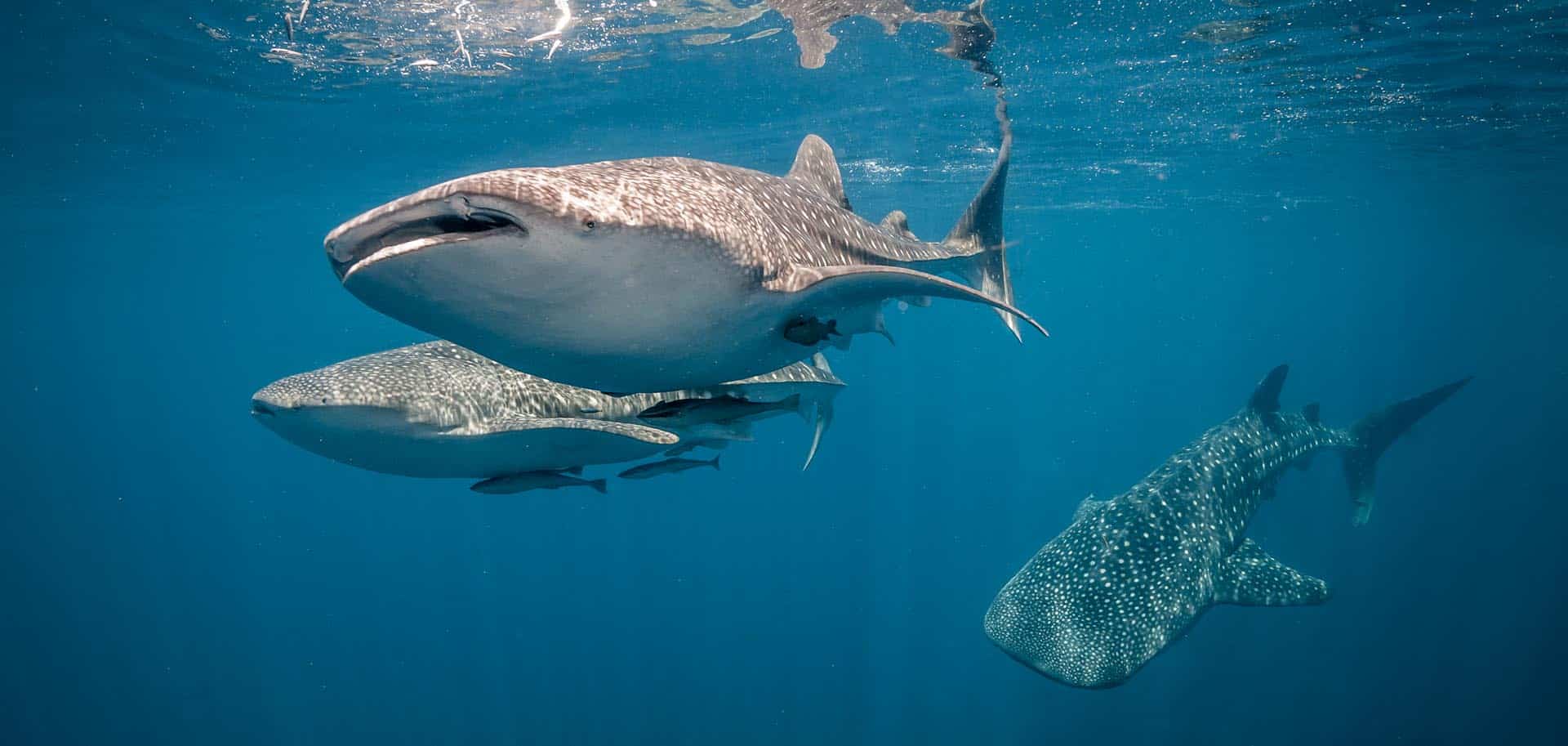
There are places in the world that quietly hold onto their magic—not through marketing or manmade attraction, but through nature simply being itself. Saleh Bay, tucked into the coastline of Sumbawa Island in Indonesia, is one of those places. And somehow, the whale sharks know it.
I’ve been chasing moments like these for years. From the Philippines to Mexico, I’ve swum alongside these gentle giants. But Saleh Bay felt different from the beginning. And as I watched my second whale shark of the morning cruise effortlessly beneath our boat, it struck me: these animals keep coming back here—for a reason.
A Natural Gathering Place
It’s not a coincidence. These whale sharks aren’t just passing through by chance. They return year after year, season after season, as if Saleh Bay were a long-lost home.
Local guides told me it has everything to do with the bay’s unique ecosystem. Protected by a ring of islands, the waters stay calm even during rougher weather. Beneath the surface, deep upwellings bring nutrient-rich waters swirling up from the ocean floor. And where there are nutrients, there’s plankton. Where there’s plankton, there are whale sharks.
Not Just a Stop—A Feeding Ground
You can almost see it in their movements. These aren’t stressed, hurried animals darting between tourist boats. They glide. They circle slowly. Sometimes they even hang vertically, gently pumping water through their massive gills to filter out the tiny krill and plankton they thrive on.
It’s easy to forget they’re the biggest fish in the ocean when they move with such ease, such calm. Here in Saleh Bay, you get the sense they’re not just visitors. They’re home.
This is what makes a real whale shark diving Sumbawa experience so special. You’re not intruding. You’re witnessing.
Why They Return: Three Unspoken Reasons
If I had to guess—not as a scientist, but as someone who’s spent a lot of time around the sea—I’d say there are three main reasons these creatures return again and again.
1. Plankton Heaven
We already talked about the upwellings. But what you may not realize is that these upwellings are predictable. Local fishers have known this for generations. They don’t use sonar or science instruments—they use instinct. Moon cycles, water clarity, surface temperature. They know when the food rises.
And whale sharks? They know it too.
2. Safe, Quiet Waters
There’s a peace to this place. Not just above water, where you might find only a handful of boats on any given morning, but below the surface too. No heavy motor traffic. No loud underwater disruptions. Just soft currents, sunlight filtering through the greenish-blue, and the occasional click of your snorkel when your breath catches in wonder.
For a creature that can grow over 10 meters long, safety matters. And Saleh Bay offers that calm sanctuary—something other feeding areas can’t always guarantee.
3. No Tricks, No Feeding
This might be the most important reason of all. In Saleh Bay, the local community and eco-guides have chosen not to feed the whale sharks. There’s no artificial baiting, no conditioned behavior. Just real nature, raw and unfiltered.
And that authenticity ripples. The whale sharks come back because they trust the rhythms of the bay—not the schedules of tourists.
A Day on the Water: My Personal Dive Story
The day began before sunrise. We met our guide at a small harbor, shared hot tea in silence, and waited for the boat to be ready. It was quiet. Not solemn, but respectful—like everyone knew we were about to be guests in someone else’s world.
When we finally motored into the deeper parts of the bay, there was no rush. No shouting. Just scanning the surface, watching for the dark speckled forms moving just under the water.
And when we did spot one—it was magic. Pure, slow-motion magic. I slipped in with mask and fins, keeping my body loose, trying not to make sudden moves. The water was clear but not tropical-blue—it had that plankton-rich green tinge that tells you life is blooming all around.
Then the silhouette came into view. A juvenile whale shark, maybe five meters long, moving steadily just ahead of me. I didn’t chase. I just floated. And for a good 45 seconds, we shared the water, eye to eye, before it dipped away into deeper green.
I’ve never felt so small, and yet so alive.
The Role of the Local Community
What impressed me almost as much as the animals was the way the local community protects them. I spoke with several guides who used to be full-time fishermen. Now, they spend their mornings helping visitors experience what they used to take for granted.
They’ve swapped nets for snorkels. Boats for conservation training. And it’s working.
Thanks to responsible tourism initiatives like the Saleh Bay whale shark tour, there’s real economic incentive for preserving this ecosystem. It’s not just about making money. It’s about building a future that keeps the whale sharks coming back.
Other Creatures in the Mix
While the whale sharks are undoubtedly the stars of the show, Saleh Bay has plenty of supporting characters. On the way back from our dive, we spotted flying fish skimming across the surface like skipping stones. A pod of dolphins breached in the distance. And above us, sea eagles circled with unhurried elegance.
It reminded me that the magic of this place isn’t just underwater. It’s in the air. In the way the land folds into the sea. In the silence between the engine stopping and the first ripple of a whale shark fin.
Timing, Not Tricks
I think that’s what I’ll take away the most from this trip. That some things can’t be rushed. You can’t make a whale shark show up on your timeline. You wait. You listen. You trust.
And when it happens, it means something.
You’re not just a tourist. You’re a witness.